Introduction
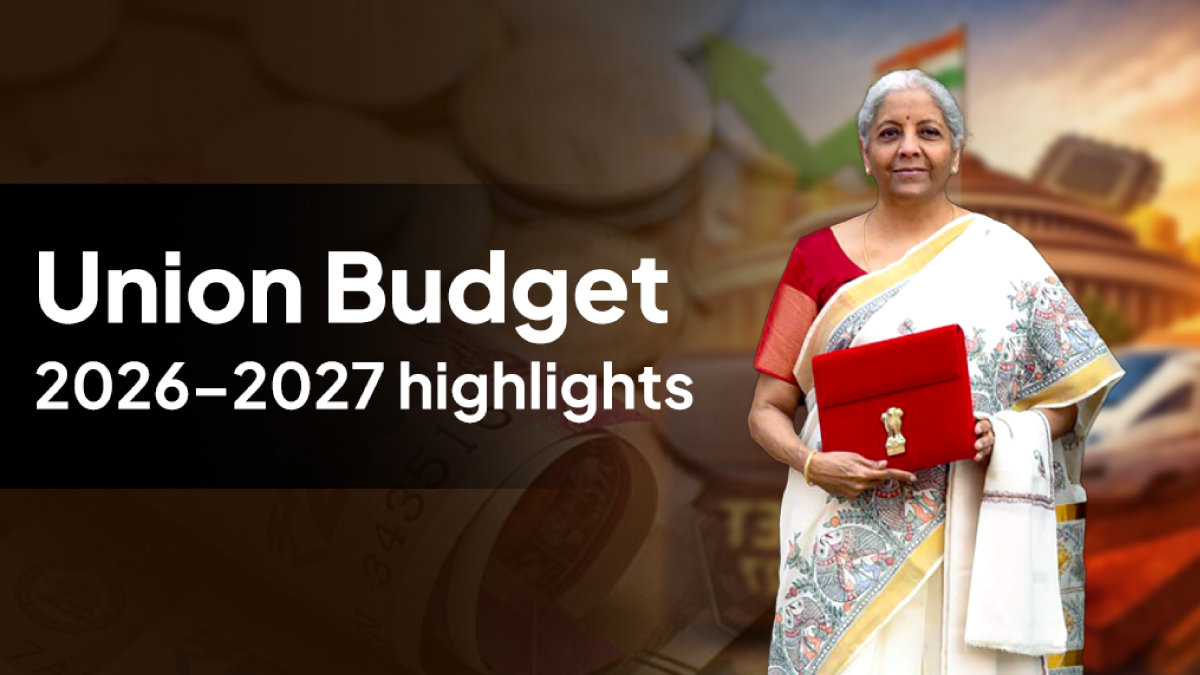
The Union Budget 2026–27 sets the financial direction for India’s economy in the coming year. Presented by Finance Minister Nirmala Sitharaman on 1 February 2026, it outlines government plans for revenue, spending, and growth priorities. While technical in parts, the Budget impacts everyday life from taxes and jobs to spending on infrastructure and financial schemes for citizens.
Quick Snapshot: Top Budget Announcements at a Glance
- No change in personal income-tax slabs
- New Income Tax Act, 2025 to take effect from April 2026
- Record infrastructure capex allocation (~₹12.2 lakh-crore)
- High-speed rail corridors and rare-earth industry push
- Simplified compliance and reduced penalties
- New incentives for MSMEs and manufacturing
- Measures for financial sector reforms
What Is the Union Budget & Why Should You Care?
The Union Budget is the Indian government’s annual finance plan outlining expected revenues and planned expenditures across sectors such as infrastructure, welfare, defence, health, and economy. It helps steer the national economy by deciding where money comes from and how it will be used over the next fiscal year.
For entrepreneurs and individuals looking to invest or expand, these budget policies create opportunities to explore personal loan options and access capital efficiently.
Income Tax & Personal Finance Changes
The 2026–27 Budget did not revise personal income-tax slabs for most individuals, helping maintain stability for taxpayers this year. However, it introduced a new Income Tax Act, 2025, coming into effect from April 2026, with redesigned forms and simplified rules aimed at easing compliance and reducing complexity. There are also changes to TDS/TCS norms, rationalised penalties, and clarified treatment of certain income categories, such as share buybacks and foreign assets.
Knowing your financial obligations allows you to calculate business loan EMI if you plan to borrow for expansion or investment purposes.
Jobs, Employment & Skill Development Push
While direct job schemes were not highlighted in formal releases yet, the Budget’s emphasis on manufacturing, digital services, and rural infrastructure is expected to create employment across sectors. Incentives for MSMEs, textile clusters, and innovation zones, along with expanded industrial activity, can support broader job creation.
Manufacturing, PLI & “Make in India” Push
The Budget bolstered India’s manufacturing ambition, expanding:
- Production-Linked Incentive (PLI) focus on advanced sectors
- Incentives for semiconductors, biopharma, electronics, and critical minerals
- Rare-earth material corridors in Odisha, Kerala, Andhra Pradesh, and Tamil Nadu
These steps aim to boost domestic value addition and global competitiveness, aligning with “Make in India” goals.
Infrastructure & Rural Spending
Infrastructure spending remains a key priority:
- Record capex allocation of ₹12.2 lakh crore to boost connectivity and growth
- Seven new high-speed rail corridors announced, including Delhi-Varanasi and Varanasi-Siliguri links
- National waterways, freight corridors, and logistics support
Infrastructure investment aims to spur jobs, tourism, and regional development.
Social Welfare & Direct Benefit Schemes
The Budget reaffirmed continued support for welfare programmes, including:
- Rural development and livestock sector support through higher allocations
- Entrepreneurship and FPO help for agriculture and allied sectors
- Enhanced schemes to support healthcare accessibility
- Subsidy rationalisation and better targeting of benefits
These initiatives help strengthen financial security at the household level.
Loans, Credit & Financial Inclusion
The 2026–27 Budget continued focus on financial inclusion with policies aimed at:
- Improving credit access for MSMEs and rural enterprises
- Supporting credit-linked schemes tied to infrastructure and agriculture
- Financial sector reforms to deepen credit markets
Measures that ease compliance and broaden access can make formal lending more inclusive.
Political Implications of Budget 2026–27
Budget policies also have political resonance:
- Stability in tax slabs can appeal to middle-class voters
- Focus on jobs, infrastructure, and manufacturing aligns with broader national growth narratives
- Support for rural economies may influence regional development and electoral dynamics
While economic policy remains distinct from politics, Budget priorities often reflect broader governance goals.
Practical Takeaways for Common People
For individuals and families, the Budget highlights mean:
- Tax continuity; no drastic changes in slabs
- Easier filing and reduced compliance burdens
- Continued infrastructure spend for long-term job creation
- Support for small businesses and rural livelihoods
- Progressive reforms aimed at simplifying financial engagement
Understanding these takeaways can help in personal financial planning and forecasting.
FAQs
1. What is in the Union Budget 2026?
It’s a detailed plan outlining government tax, spending, and policy priorities for FY 2026–27.
2. Will income tax rates change this year?
Slabs remain unchanged; however, compliance processes and TDS/TCS norms are updated.
3. How does the Budget affect loans and credit?
By encouraging infrastructure projects and loan accessibility for enterprises, financial inclusion is supported.
4. What are the major infrastructure announcements?
Record capex allocation and new high-speed rail corridors are key highlights.
5. Is the Budget people-friendly?
Yes. Tax stability, welfare focus, and infrastructure investments are designed to benefit broad segments.