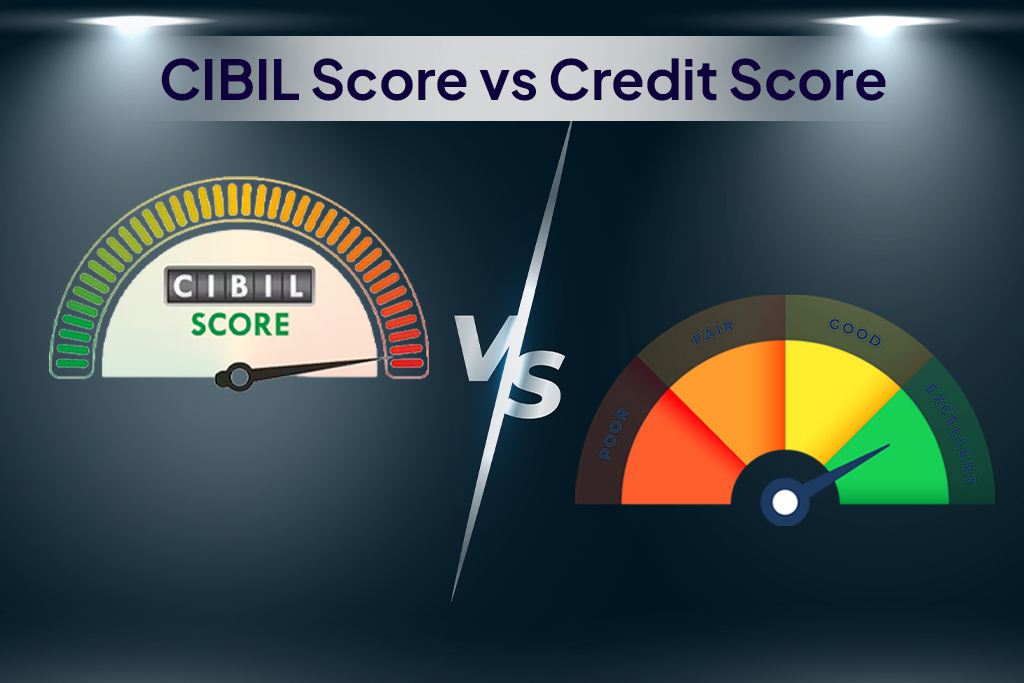
Introduction – Why People Confuse Credit Score and CIBIL Score
When people talk about loans or financial health, the terms credit score and CIBIL score are often used interchangeably. This leads to a common question: are credit score and CIBIL score the same?
While both represent your creditworthiness, there is a technical difference between them. Understanding the difference between credit score and CIBIL score helps borrowers make better financial decisions and monitor their credit profile more accurately.
In this guide, we explain the concepts clearly and help you understand credit score vs CIBIL score.
What Is a Credit Score?
A credit score is a three-digit number that represents how trustworthy you are as a borrower. It reflects your ability to repay loans based on your past credit behaviour.
The score is generated using information from your credit report, such as:
- Loan repayment history
- Credit card usage
- Outstanding debts
- Credit enquiries
- Length of credit history
Typically, the credit score range falls between 300 and 900, where a higher score indicates better creditworthiness.
Understanding what is credit score is important because lenders use it to evaluate loan applications.
What Is a CIBIL Score?
A CIBIL score is a specific type of credit score generated by TransUnion CIBIL.
In simple terms:
- Credit score is the general term
- CIBIL score is a credit score issued by the CIBIL bureau
So when people ask what is CIBIL score, they are referring to the credit score calculated by TransUnion CIBIL based on your credit report.
CIBIL Score vs Credit Score – Key Differences
Understanding the credit score vs CIBIL score comparison becomes easier with a simple breakdown.
| Feature | Credit Score | CIBIL Score |
| Definition | Generic term for creditworthiness score | Credit score provided by TransUnion CIBIL |
| Issuing Authority | Multiple credit bureaus | TransUnion CIBIL |
| Score Range | Usually 300–900 | 300–900 |
| Usage | Used by lenders to evaluate credit risk | Used by lenders widely in India |
So the key difference between credit score and CIBIL score is that CIBIL score is one specific type of credit score.
Why Does the Confusion Exist?
The confusion arises mainly because CIBIL is one of the most widely used credit bureaus in India.
Other major credit bureaus include:
- Experian India
- Equifax India
- CRIF High Mark
Since lenders frequently refer to the CIBIL score, people often assume it is the only credit score available.
In reality, all credit bureaus generate their own credit scores based on your financial data.
Importance of Checking Your Credit Score
Monitoring your credit score regularly helps maintain strong financial health.
Benefits of Checking Credit Score
| Benefit | Explanation |
| Better Loan Eligibility | Higher score improves approval chances |
| Lower Interest Rates | Lenders may offer better rates |
| Early Error Detection | Helps identify incorrect information |
| Financial Awareness | Understand how credit behaviour affects score |
Regularly reviewing your credit profile helps you stay prepared before applying for loans.
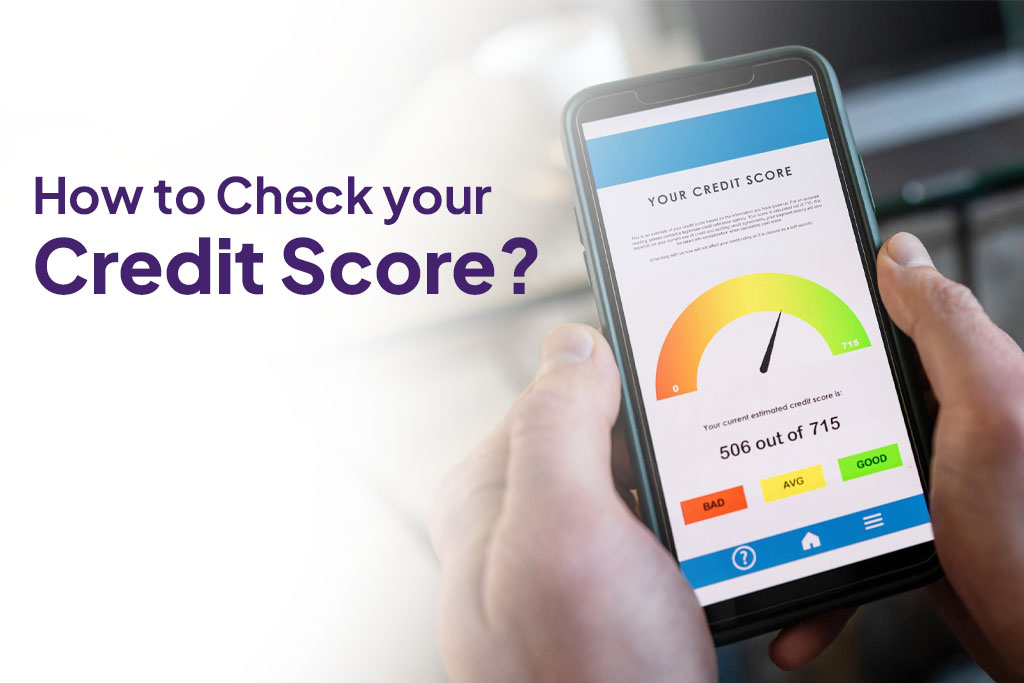
How to Check Your Credit Score and CIBIL Score
Today it is easy to monitor your credit profile through digital platforms.
You can check your credit score through:
- Credit bureau websites
- Banking apps
- Fintech platforms
- Credit monitoring tools
Products like FatakUdaan from FatakPay help users track their credit health more effectively.
With FatakUdaan, users can:
- Check their credit score
- Understand their credit behaviour
- Monitor credit profile changes
- Learn how to improve their credit score
Using such tools regularly makes it easier to stay financially prepared before applying for loans or credit products.
Conclusion
Understanding credit score vs CIBIL score helps eliminate a common financial misconception. While both terms are related, a CIBIL score is simply a specific credit score generated by the TransUnion CIBIL bureau.
Monitoring your credit profile regularly is important for maintaining financial stability and improving loan eligibility.
Digital products like FatakUdaan from FatakPay help users stay informed about their credit health and make better financial decisions.
By tracking your score and practising responsible credit behaviour, you can build a strong financial foundation for the future.
FAQs
1. What is the difference between credit score and CIBIL score?
A credit score is a general term, while a CIBIL score is a specific credit score issued by TransUnion CIBIL.
2. Are credit score and CIBIL score the same?
They are related but not identical. CIBIL score is one type of credit score.
3. What is a good CIBIL score in India?
A score above 750 is generally considered good for loan approvals.
4. Which credit bureaus operate in India?
Major credit bureaus in India include TransUnion CIBIL, Experian, Equifax, and CRIF High Mark.
5. How can I check my credit score?
You can check your credit score through credit bureau websites or digital financial platforms offering credit monitoring services.
| Personal Loans by City | ||||
|---|---|---|---|---|
| Personal Loan Bengaluru | Personal Loan Thane | Personal Loan Mumbai | Personal Loan Hyderabad | |
| Personal Loan Pune | Personal Loan Surat | Personal Loan Coimbatore | Personal Loan Delhi | |
| Personal Loans by Amount | ₹60,000 Personal Loan | ₹3 Lakh Personal Loan | ₹5 Lakh Personal Loan |
|---|